University at Buffalo (UB)
Shaping the Future of City Transit: Alumni Lead Micromobility Innovation
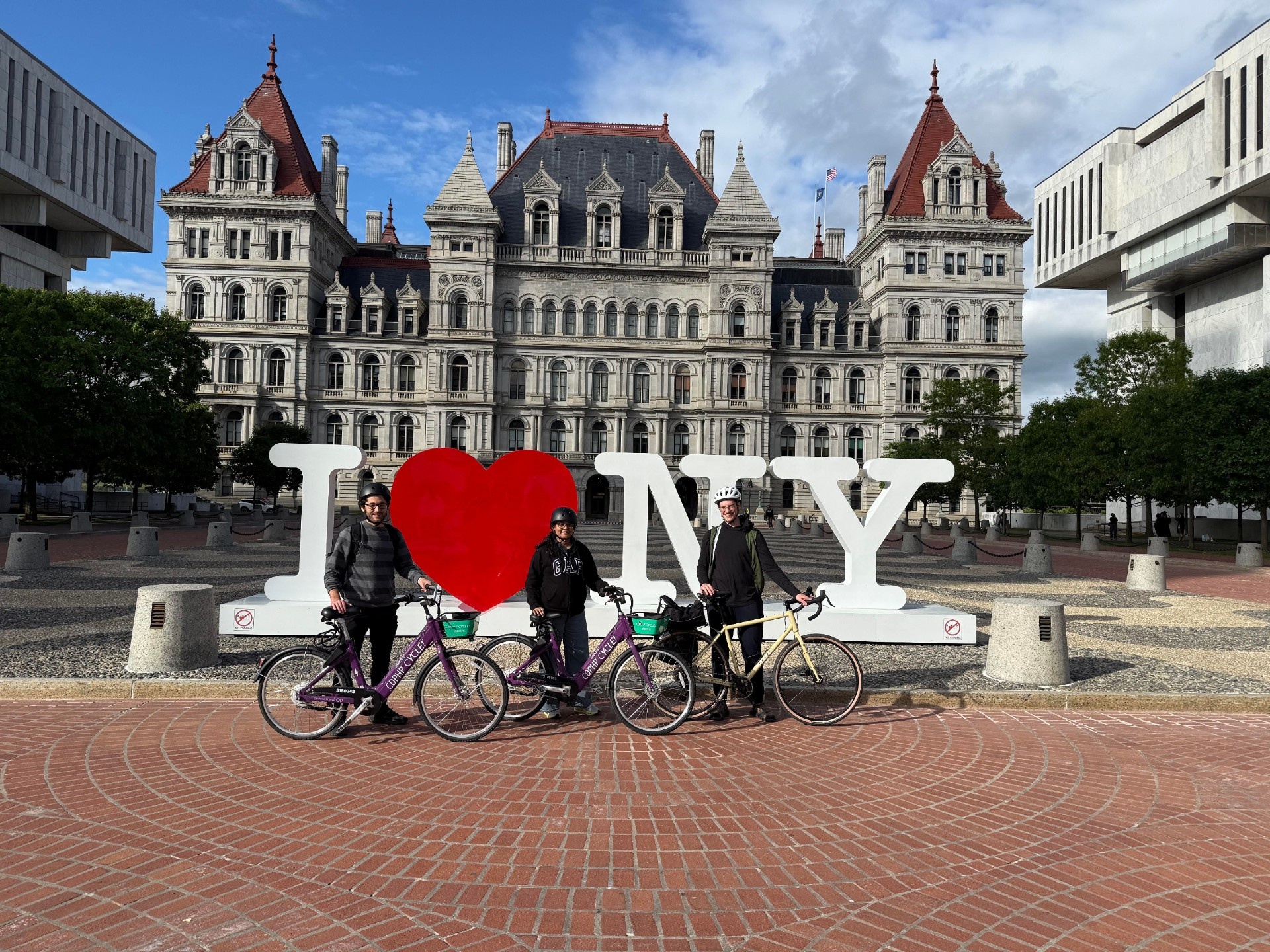

Shared Mobility Inc works to build mobility systems in Buffalo and beyond. Pictured (left to right) are UB alumni Tyler Madell (MUP '20), Viyona Chavan (MUP '24), and Alex Maccallini (MUP '24).
Kelly Sheldon November 14, 2025
During his final year in the Master of Urban Planning program at the University at Buffalo, Michael Galligano (MUP ’09) and a group of his classmates developed an idea for a community-based car-share business. With support from a New York State Energy Research and Development Authority (NYSERDA) grant, they launched Buffalo CarShare before they even graduated.
That student-led startup has evolved into Shared Mobility Inc (SMI), now a nonprofit organization that has spent the last 15 years dedicated to expanding equitable transportation options in Buffalo and beyond. Although the original car-share program was sold a decade ago due to challenges posed by state insurance law, SMI now leverages cutting-edge technology and best practices to build mobility systems that serve disadvantaged communities in small and mid-sized markets.
Throughout SMI’s journey, more than 20 individuals affiliated with UB’s Department of Urban and Regional Planning—faculty, students, and alumni—have contributed to SMI as employees, interns, volunteers, and board members. Today, four MUP graduates are part of the team: Galligano, Tyler Madell (MUP ’20), Alex Maccallini (MUP ’24), and Viyona Chavan (MUP ’24). Two alumni are also at the helm of the organization’s board of directors: Board Chair Jamie Hamann-Burney (MUP ’11) and Vice President Angela Keppel (MUP ’09).
As a program manager at SMI, Maccallini leads Project Mover, an initiative that brings e-bike sharing and rebates to Westchester County, supported by NYSERDA’s Clean Transportation Prize. Under Maccallini’s leadership, the program has expanded from 11 bikeshare hubs in one municipality to 48 hubs across six municipalities in less than a year.
Viyona Chavan
In planning, you need to listen to people first. It’s a lot more writing, a lot more soft skills like interviewing community members. That’s one of the reasons I gravitated toward planning.
Project Mover also launched New York State’s first E-Bike Rebate Program, which has since expanded to Buffalo and Niagara Falls. The program offers vouchers to qualifying low-income residents that cover up to 80% of the cost of a personal e-bike. Maccallini recalled the first rebate recipient— a nanny whose new e-bike cut her commute time by 40 minutes, helped her easily connect to a regional train station, and gave her access to better grocery stores.
“To me, that freedom is really what I want to give as many people as possible through this job,” Maccallini expressed.
Chavan had studied architecture in undergrad but pivoted to urban planning for her graduate degree. “In planning, you need to listen to people first,” she shared. “It’s a lot more writing, a lot more soft skills like interviewing community members. That’s one of the reasons I gravitated toward planning.”
Over just nine months, Chavan has led SMI’s development of clean mobility plans for Buffalo, Albany, and Angola, developed in collaboration with local transit authorities and community partners and tailored to each area’s infrastructure and needs as identified by the people who live there. SMI is currently pursuing grants to implement these plans, which would greatly improve micromobility access in these areas through added amenities like EV charging stations, e-bike and scooter storage, and expanded access to carshare and bikeshare services.
Additional SMI programs include Buffalo’s ubiquitous Reddy Bikeshare, nationwide e-bike libraries built from repurposed Uber JUMP bikes, and influence on statewide transportation policy. “We’re in bigger circles and making more influence with states and our municipal partners across the state and our transit authorities,” Galligano explained. “We’re in the room, and we’re making differences in that way.”
For these UB alumni, their common educational background has provided a solid basis for shared understanding and a commitment to high standards for quality of work. “It’s beneficial because a lot of things can go unsaid,” Maccallini noted. “We don’t have to talk about the impacts of redlining or understanding why it’s important to subsidize efforts or improve access to transportation.”
Galligano added, “UB’s planning school taught us a way of thinking, a way of constructing and deconstructing problems, divergent thinking—all these avenues through which we are consistently inventing something.”


Community engagement and listening are important components of SMI's work.
Beyond technical knowledge and skills, their UB education also instilled the soft skills essential for success in the planning field.
“I learned a lot of the skills that I use in my everyday job,” Maccallini observed. “Going to meetings, making agendas, following up with people afterward—and the ability to craft a story. Planning is a lot of storytelling, and my time at UB helped me refine my ability to create a narrative around the way we see the world through writing and mapping.”
As an international student, Chavan found particular value in UB’s introductory planning courses, which provided essential regional context and historical insight. “Coming from India, I didn’t have this background, but it helped me to understand more about Buffalo’s history and urban landscape.”
Galligano particularly remembers the influence of his professors. “Each professor had a different view of what planning was, and they countered each other as well,” he recalled. “I remember going to the Buffalo Niagara Medical Campus (BNMC) for the first time and learning about how awesome it is while in the same semester, another professor was explaining the racial issues with the BNMC and the redlining and how it affected historically disadvantaged communities. Having both lenses was valuable.”
When Maccallini and Chavan applied to SMI following their graduation in 2024, Galligano was pleased to see they both listed SUNY Distinguished Professor Samina Raja—who also had a profound influence on him—as a reference. “It was great to have the opportunity to talk to her. Her word is pretty much gold, so I knew I had good folks coming in.”
The UB alumni network continues to be a powerful force in shaping Buffalo’s urban landscape, and with many former classmates now working across the city, collaboration comes naturally. “A lot of the people from our studios are working in the city as well,” said Maccallini. “The dynamic we formed in studio and the relationships built have lasted beyond graduation.”
Galligano is optimistic about this network’s potential to make a difference. “UB keeps turning out good planners who can create movement. They lead nonprofits and other organizations, and they work in administration for the city, helping to raise visibility for mobility issues. There’s a huge need for improvement, and we also see a bright light at the end of the tunnel with the change in administration that may allow for more innovative thought when it comes to mobility.”
For Chavan, originally from Mumbai, Buffalo’s dependence on automobiles was surprising when she first arrived here, but that makes her work at SMI feel even more meaningful. “There are changes that need to happen, but at SMI, I can make a difference,” she shared. “We are on the ground, we listen to people, and we understand transportation difficulties. I know I’m making a difference to the Buffalo community.”