University at Buffalo (UB)
Commencement 2026

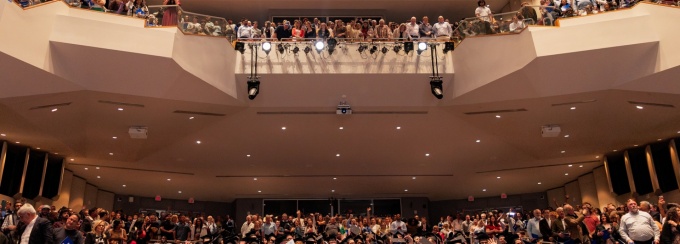
54th Commencement
On May 15, 2026, 197 graduates in architecture, environmental design, urban planning and real estate development crossed the stage at the 54th commencement ceremony of the School of Architecture and Planning. Graduates and their families and friends, along with members of the University's senior leadership, assistant and associate deans, faculty, staff, and distinguished guests, joined together to celebrate what is always a proud moment - the sending-off of a new cohort of future leaders for our professions and our world. Presiding over the ceremony was Erkin Özay, chair and associate professor in the Department of Architecture.
Commencement program
View an accessible PDF of the program, including a listing of all graduates.
On this page
Photo Gallery
Photos by Jackson Zimmerman
Message from the President


It has been one of the great privileges of my life to celebrate our UB graduates and witness your growth. As I conclude my presidency this summer, I find myself, like you, standing at the edge of something new. That is why this ceremony holds a special meaning for me. I am grateful to share it with you today.
Satish K. Tripathi
UB President
Among the ceremony's distinguished guests was UB President Satish K. Tripathi, who greeted graduates on behalf of the university and served as degree conferrer as he prepares to step down as president. Since being named UB president in 2011, Tripathi has presided over 150 commencement ceremonies and the awarding of more than 140,000 degrees. The university’s 15th president and longest-serving in the modern era, Tripathi oversaw UB’s rise among the university ranks, growth in sponsored research expenditures, a billion-dollar fundraising campaign and the transformation of its three campuses. He was presented with the Chancellor Charles P. Norton Medal, UB's highest honor, on Sunday, May 17, at the College of Arts and Sciences' commencement ceremony.
In his remarks, Tripathi called upon graduates to carry forward UB's mission of advancing knowledge and serving society. "If we have done our job well you leave with a deeper appreciation for the resilience of our shared humanity while also recognizing where it is fraying. No doubt, you will encounter trials in the coming years - uncertainty, disagreement, division. In these instances, I urge you to resist the impulse to withdraw and look past them. Instead, engage. Draw on what you have learned here to renew the fabric of our communities."
Keynote Address and Dean's Medal Awardee


"One thing manypeople struggle with is how to make their profession something they can stay with over time, through twists and turns. And my advice is your journey isn't a solo performance. It also doesn't need to be a highly coached team sport. But it does need something in the middle, which is the group."
Ann Forsyth
Ruth and Frank Stanton Professor of Urban Planning, Harvard Graduate School of Design
Trained in both planning and architecture, Ann Forsyth has built a career at the intersection of design and research, asking how we create healthier and more sustainable cities, particularly in an aging and rapidly changing world. Through influential studies of new towns, suburban development, and healthy place-making, her work has illuminated both the promise and the complexity of designing environments that support well-being, aging in place, and inclusivity.
Forsyth was presented with the Dean's Medal, the School's highest honor, recognizing her lifetime achievement and leadership in our disciplines and professions. The Dean's Medal was presented to Forsyth by Emmanuel Frimpong Boamah, chair and professor in the Department of Urban and Regional Planning, on behalf of Dean Julia Czerniak, who was not able to attend the ceremony. "For Professor Forsyth, our disciplines are rooted in a clear conviction: that the built environment is not merely a backdrop to human activity, but an active force in shaping outcomes," said Boamah. "Her career reflects a rare combination of intellectual leadership, generosity of service, and an enduring commitment to more just, healthy, and sustainable cities and places."
In her remarks, Forsyth set graduates on their way by offering three things: to tell a secret, give advice, and help graduates find their "kangaroo story." The secret: she attended her graduation ceremony only because she lost a bet with her parents. "This is because what matters to me is the journey as a whole, not the stops along the way," she said. Her advice: "Managing a career and a life is four-dimensional - working out opportunities and challenges in space and time. This is really hard to do on your own. So my strong belief from mentoring what are now thousands of students is that you need at least three groups." These groups are advisory (people who are further along the path); peer review (people providing supportive feedback that might also be critical); and support (family and friends). And, finally, she recalled her Australian roots and family's many kangaroo rescue stories. As an immigrant to the U.S., "I had to find things that could speak across silos, disagreements, backgrounds, and opinions, and it turns out kangaroo stories do that," she said. "And once you've shared a kangaroo story, the next conversation is a bit easier. That's a skill needed today even if you aren't from somewhere else, given the divisions in the world."
I would like to thank the School of Architecture and Planning for inviting me today. You are graduating from incredibly important fields that can make a real difference in the world.
Talks like mine are meant to do a lot in a few minutes to set you on your way. It is really impossible. So I am going to do just 3 things. Tell you a secret, give you advice, and help you find your kangaroo story.
The secret is that I have attended dozens of graduations, but I only went to one of mine, the first one, and that was because I had lost a bet with my parents. This is because what matters to me is the journey as a whole, not the stops along the way. Though I do know reasonable people disagree, and for some the stops are important.
But that means my advice focuses on the journey, rather than endings and beginnings.
So considering the journey, one thing many people struggle with is how to make their profession something they can stay with over time, through twists and turns. And my advice is your journey isn’t a solo performance; it also doesn’t need to be a highly coached team sport. But it does need something in the middle, which is the group.
As we know from recent events, the world is complicated and unpredictable, or more positively, it is full of emerging opportunities and challenges that are hard to foresee. Managing a career and a life is four-dimensional—working out opportunities and challenges in space and time. This is really hard to figure out on your own. So my strong belief from mentoring what are now thousands of students is that you need at least 3 groups.
The first is an advisory group—people with more experience you can turn to from time to time for guidance. To make the group look for people with glimmers of interest in you. A person at work who seems savvy and willing to talk; someone who responds well when you present a project; or a former faculty member who answers your emails.
These are people you could rely on to answer an email or two a year, or to meet at a conference, or take the occasional Zoom. To change the world, it helps to do it competently and the advisory group can really help. I've had this kind of group myself. They’ve never known I saw them as my group, and I tried not to bother them too much, but they’ve made a key difference.
So that’s the advisory group—people who are further along the path. The second is what I call a peer review group — people providing supportive feedback that might also be critical! For graduating students, your peers around you can be the start of that group. Or you can join a professional association, or maybe colleagues at work. This mustn't be just about validation, but also about review and criticism to improve your work.
Finally, there is the support group to give you acknowledgment without too much criticism. Part of your support group is sitting here today—family and friends.
So that’s my secret about the importance of the journey, and my advice about finding your advisory, peer, and support groups. And now to my kangaroo stories. I'm from rural Australia, and for a few decades, my family did kangaroo rescue. This is not common, and you never own a kangaroo—they are wild animals, and we had to get permission from national parks and wildlife to do so. I have stories about trusting kangaroos, violent kangaroos, and a kangaroo helping repair a car (which involved bumping the power steering back on; it was really amazing). I do quite a good impression of different kangaroo movement styles. But telling you the stories would take a long time, so I want to get to the punchline.
In Australia, kangaroo stories aren't that interesting; there are a lot of kangaroos, so I didn't really tell them until I became an immigrant and came to the US. where I didn't share a history with others. All the jokes here seemed to refer to popular culture I didn’t know. So I had to find things that could speak across silos, disagreements, backgrounds, and opinions, and it turns out kangaroo stories do that. And once you've shared a kangaroo story, then the next conversation is a bit easier. But that’s a skill needed today even if you aren’t from somewhere else, given the divisions in the world. Now, some of those divisions are really hard to bridge, as my university has experienced with the federal government. But not all divisions are so firm. So my third point is to find your kangaroo stories—something about life’s surprises, your own foibles, and things that go wrong that have a lesson—stories that will help you reach out to others who are not like you as you try to improve the built environment.
So that's my advice: this commencement is a step on a journey; you need to find your groups and also tap into your version of a kangaroo story. Congratulations to the class of 2026.
Student Speaker

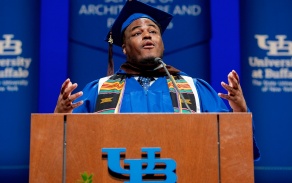
With a spirited delivery, Ya'Ukku closed his remarks with a rallying call: "My fellow graduates, our task is not small. Yet history shows that cities evolve through the conviction of those willing to plan boldy and buld responsibly. Let us approach this moment with rigor, humility, and imagination."
Tendaji Ya'Ukku
BAED '26 | Co-Founder, East Side Stewards
Tendaji Ya’Ukuu, a graduate of the BA in Environmental Design and current student in UB's Master of Urban Planning program, is a tenacious land steward and community builder shaped by lived experience, community work, and study. Raised in the South Bronx (NYC), where food insecurity and environmental
injustices were daily realities, Ya'Ukku learned early the importance of collective care and resilience. Those roots continue to guide their work in Buffalo, N.Y., where Ya'Ukku co-founded East Side Stewards to cultivate land and create pathways for neighbors to reconnect with food, soil, and one another.
Selected to deliver this year's student address through a competitive application and audition process, Ya'Ukku reflected on his student experience at UB and how it has prepared graduates for the challenges of a complex and divided world. From the housing crisis to a warming planet to geopolitical conflict, Ya'Ukku said: "These are not abstract headlines; they are challenges that require the creativity and expertise we have cultivated at UB." Referring to their participation in UB's entry in the Urban Land Institute's Urban Plan competition, which tasked the group with planning for the redevelopment of an entire neighborhood, Ya'Ukku finds hope in the collaborative agency of the built environment professions. "Structured around distinct roles and a site burdened by disinvestment, competing priorities, and fiscal restraint, the exercise made plain that design, policy, and capital only produce equitable outcomes when they are accountable to one another."
Good evening faculty, families, friends, and most excitingly, the Class of 2026.
A few years ago, I walked onto a neglected lot that most people had stopped seeing. It was overgrown and littered with thousands of pieces of trash. From a market perspective, it carried little monetary value. On a satellite map, it was just another patch of grass with a central gazebo. Yet when I spoke with neighbors, a different geography emerged. Children crossed it on their way home from school. Elders gathered there in the late afternoon sun. This community garden was woven quietly into their daily life. What appeared vacant on paper was active in memory and movement.
We graduate into a complex world. The United States faces a housing deficit exceeding 3.8 million units, while climate data confirms the past decade as the warmest on record, with billion-dollar disasters increasing. Global supply chain disruptions and geopolitical conflicts show how deeply interconnected our infrastructure and communities are. These are real life challenges that require the creativity and expertise we have cultivated at University at Buffalo.
As a planning student the highlights of my scholarship have been co-creating a comprehensive plan for Lasalle Park on Buffalo’s waterfront, redesigning Hayes Lawn on South Campus for greater student and University District resident engagement and opportunity, and creating a robust proposal for activating parking lots and commercial corridor along our Main Street for a shared Arts, Food, and Retail Commons built on informal social capital and infrastructure.
Awarding me one of the highest achievements within the undergraduate planning degree.
Along the way, I’ve treasured moments like hosting the 2023 UB Undergraduate Student Association’s International Fiesta, celebrating community and culture, and leading the Get Seeded competition at the UB Co-Lab, where student ideas became visions for Buffalo’s future. I've also survived the 2 a.m. RA calls from freshmen who apparently thought they were the Road Runner, I swear I heard some of them go beep-beep… Ultimately, every experience, every challenge, and every mentor has shaped how I approach people, projects, and possibilities.
Our disciplines sit at the center of this recognition. Architecture, planning, and real estate shape land use patterns that influence both the physical footprint of our regions and the social, economic, and environmental systems that sustain them; determining patterns of energy consumption, mobility, and carbon emissions, framing access to education, jobs, and health, and either reinforcing or bridging divides across the nation. The most concrete example for collaboration between these three disciplines was our ULI Urban Plan competition, tasking us with redeveloping an entire neighborhood. Structured around distinct roles and a site burdened by disinvestment, competing priorities, and fiscal constraint, the exercise made plain that design, policy, and capital only produce equitable outcomes when they are accountable to one another. We honor that lesson by carrying those faculty, peer, and community partner relationships into practice. Resilience and prosperity in this context requires adaptive policy, ethical development practice, and sustained civic engagement. Especially as we observe the 5/14 TOPs Massacre, that occurred in 2022 on Jefferson Ave, and honor the 10 Black lives taken away from hatred, our future work demands fluency in historical context, civil rights, cultural humility, neighborhood level resiliency, economic development, environmental and food justice and human behavior.
Through my work leading East Side Stewards, an organization mobilizing community-led redevelopment on the East Side of Buffalo, I have seen how sustained presence, grounded in trust and active listening, can shift a neighborhood’s trajectory. In areas long defined by disinvestment, even small, deliberate interventions, building a play ground, sowing seeds, breaking bread, mowing the lawn, create spaces that residents can reclaim and activate. We have
transformed unbuilt parcels into stewarded green spaces hosting youth programs, facilitating green workforce development, food distribution, and community gatherings. What changes is both the land we inhabit and civic imagination, as neighbors see that investment can align with their vision and foster shared ownership of the future.
My fellow graduates, our task is not small. Yet history shows that cities evolve through the conviction of those willing to plan boldly and build responsibly. Let us approach this moment with rigor, humility, and imagination. The landscapes ahead of us need critical thinkers, professionals willing to be curious, courageous, and committed to shaping places that are equitable, resilient, and alive with possibility.
Thank you, and let us go forward ready to turn our shared vision into reality! Congratulations Class of 2026!
Awards
Department of Architecture
Alpha Rho Chi Medal: Simarjit Kaur
ARCC/King Student Medal for Excellence in Architectural and Environmental Research: Allison Presutti
AIA Award for Academic Excellence: Jessica Taylor Renn
Department of Urban and Regional Planning
MUP Best Professional Project Award: Gregory Matthew Dionne
AICP Planning Excellence Award: Madeleine Hall McGrady
In Memorium
Donald (Don) Glickman
Donald (Don) Glickman, Faculty Emeriti, worked as a designer, architectural planner
and program head before going on to teach at the University of Wisconsin-Milwaukee and the University at Buffalo School of Architecture and Planning, where he was chair of the Design Studies Department. He was known for being irreverent and devoted to students. As his health declined, he designed a post card that his daughter sent following his death to more than one hundred of his favorite people, including former students, with the message, “If you’re reading this, I’m dead, and I really liked you.” This went viral and was featured in People magazine, The Washington Post, the CBC, and MSN!
Annette LeCuyer
Annette LeCuyer, Professor in the Department of Architecture, graduated from the
University of Colorado with a BFA, studied weaving in Finland and subsequently worked as a journalist in Europe before moving to London, where she received professional and graduate diplomas from the Architectural Association. She joined Foster Associates, worked on the design of the Royal Opera House in Covent Garden and went on to become an associate at Allies & Morrison Architects, where she led design teams for award winning projects in London and at Cambridge University. In 2016, she received the UB Meyerson Award for Distinguished Undergraduate Teaching and Mentoring in recognition of her outstanding commitment to and participation in the undergraduate creative experience. She exemplified our highest values through her outstanding teaching and research, as well as her leadership, mentorship, and generosity.
Questions? Contact Us
- ap-commencement@buffalo.edu
- (716)829-5916
Social Media Hashtags
- #UBClassof2026
- #UBuffalo
- #UBuffaloArchPlan
- Tag us on Instagram! @UBuffaloArchPlan