University at Buffalo (UB)
UB-RIT-Wendel team wins national home design competition
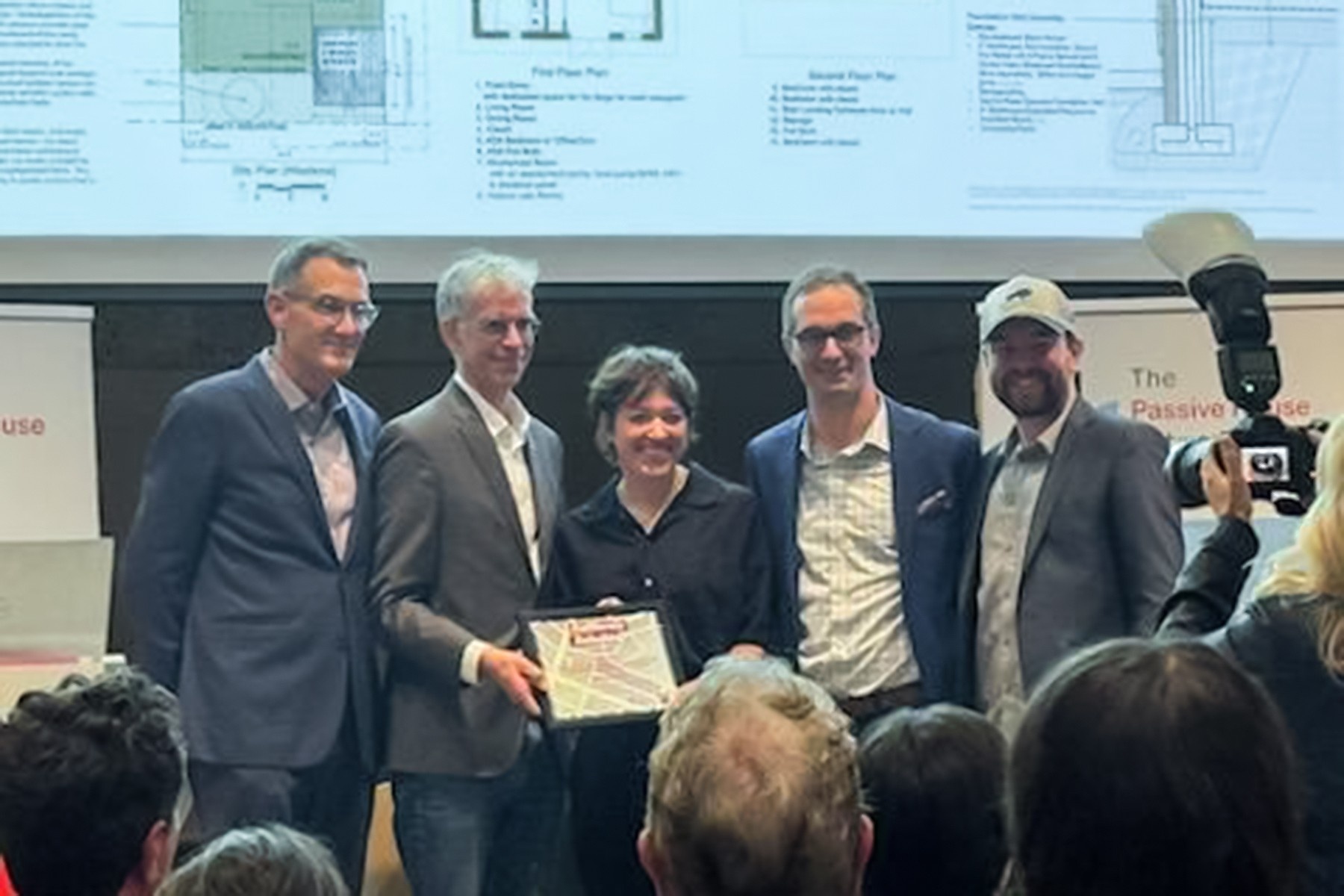
UB-RIT-Wendel design team members Laura Lubniewski (center), Nate Heckman (second from right) and Chris Osterhoudt (far right) accept the first-place award in the California Rebuilds: A Passive House Design Competition's Craftsman architectural style category.
David J. Hill November 5, 2025
BUFFALO, N.Y. — The California wildfires that devastated entire neighborhoods in the Los Angeles area exposed a need for building fire-resilient homes that are also innovative. A team of architects representing the University at Buffalo, Rochester Institute of Technology (RIT) and Wendel Companies has won a national competition that seeks to develop a groundbreaking catalog of high-performance homes to inspire and inform rebuilding efforts in the Altadena and Pacific Palisades communities.
The Passive House Network and Passive House California sponsored California Rebuilds: A Passive House Design Competition, which asked architects to design for rebuilding houses for climate and fire resilience after the recent Los Angeles wildfires. Winners were announced Tuesday (Nov. 4) as part of the Greenbuild International Conference and Expo in Los Angeles.
Laura Lubniewski, clinical assistant professor in UB’s School of Architecture and Planning, teamed up with fellow UB architecture alumni and former UB adjunct instructors Nate Heckman, a visiting lecturer at RIT’s Golisano Institute for Sustainability who previously worked remotely for Resource Refocus in Berkeley, California, and Chris Osterhoudt, director of sustainability with Wendel Companies, to create the winning design in the competition’s Craftsman architectural style category.
Competition teams had to design a house with three to four bedrooms and at least two bathrooms while adhering to a set of design parameters that included meeting the Passive House Institute (PHI) Classic certification or higher and California’s new Wildland-Urban Interface (WUI) Code, while also considering affordability and aging in place.
According to the Passive House Network, a passive house is one that through its design and construction produces dramatic reductions in building energy usage and carbon emissions while prioritizing human comfort and health.
Lubniewski, Heckman and Osterhoudt called their entry ReCraftsman: A Design for Rebuilding, paying homage to the Craftsman style of building while acknowledging current and future climate risks.
In their competition entry, they explain that the traditional characteristics of historic Craftsman houses — such as wood siding, exposed wood rafter tails and roof overhangs, or exposed wood structural elements — “are contrary to the well documented details and strategies for passive house and fire resilient design.”
As such, they say, “a new style — a ReCraftsman — integrates passive house and fire-resistant detailing to the traditional Craftsman massing as a way to honor the architectural legacy of Los Angeles while confronting the contemporary issues of energy efficiency and fire-resilient construction for rebuilding that is more than restoration — it embodies resilience, adaptation, and hope.”
“The quintessential characteristics of Craftsman houses such as exposed wood rafter tails pose particular fire risks,” they note. “Therefore, ReCraftsman simplifies these elements, encloses the eaves and overhangs with fiber cement soffit panels to reduce pockets where embers and hot gas/air can collect during a wildfire to reduce the risk of ignition.”
A fire-resilient home also requires a strategic site design, the team notes, adding that their design’s compact footprint and strategic placement within required setbacks create defensible space. Covered outdoor spaces are designed with fire-resistant materials.
A number of passive house strategies are integrated into the home design, including deep overhangs and strategically placed windows to reduce solar heat gain while maintaining the Craftsman style’s signature emphasis on indoor-outdoor connection with a generous front porch. Entrants were required to complete a Passive House Planning Package (PHPP) spreadsheet, inputting passive envelope components and specifying active heating, cooling and ventilation equipment to prove that they met Passive House’s energy standards.
ReCraftsman’s universal design features include a fully accessible bedroom and full bathroom on the ground floor, as well as wide doorways, accessible fixtures and the ability to move around the home without barriers.
Lubniewski (BS ’11), Osterhoudt (BS ’13, MArch ’15) and Heckman (BS ’13, MArch ’16) are all UB architecture alumni, have taught in the Environmental Systems track and have been or are currently affiliated with the UB Resilient Buildings Lab, which focuses on researching the impact of climate change on the built environment.
“It was a nice collaboration across universities in New York State and between academia and industry,” Lubniewski says of the experience of working on the competition together with Heckman and Osterhoudt. “The collaboration was an extension of previous experiences when Nate and Chris were graduate students working on the GRoW Home, when Chris and I worked at Wendel together, and when Nate and I co-taught UB’s Environmental Systems 3.”
Media Contact Information
David J. Hill
Editor, UBNow
Tel: 716-645-4651
davidhil@buffalo.edu