University at Buffalo (UB)
The Resilient Campus


Exhibition Dates
January 28–March 13, 2026 • Mon–Fri 9:00 a.m.–4:30 p.m. • Crosby Hall, Room 116, UB South Campus
Challenge

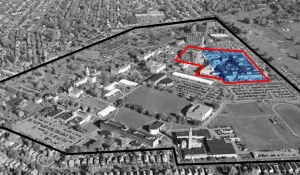
Campus Border (outlined in black); Health Science Complex (outlined in red); Farber/Sherman portion (blue).
The Resilient Campus challenges architects, landscape architects, planners, and other allied design professionals to boldly envision the University at Buffalo’s South Campus—a public campus on its way to becoming carbon neutral—as a socio-ecologically integrated landscape that engages the pressing and intertwined challenges of climate change. As a forward-looking academic environment, its design should foster a resilient, adaptable, and inclusive setting that recognizes and integrates the interdependencies among its many constituencies and species, human and non-human.
The impacts of climate change and its attendant crises are reshaping the way we design, inhabit, and sustain our built environment and the living landscape systems that support it. Within the context of a planetary polycrisis—the cascading, systemic, and interconnected risks and impacts posed by climate change (global heating), biodiversity loss (extinction) and human vulnerability (suffering) – traditional, disciplinary-based approaches and design practices have limited value. Universities, as hubs of innovation and experimentation, are uniquely positioned to lead the charge in both catalyzing and fostering the evolution of new resilient landscapes and buildings—and designers can help to envision them. We must think beyond our current approaches and conventions to move from best to next practices in our fields that will advance diverse and integrated strategies across all scales of the built and living environment. The path toward a resilient future requires constructing a complex synergy: through what we knew, what we now know, and what we imagine; through new and novel collaborations; and through thoughtful recovery and modification of what we already have.
The challenge foregrounds resilience and sustainability—both crucial for long-term well-being—as related but distinct concepts that focus on different aspects of a living system's ability to thrive and to flourish. Resilience refers to a complex socio-ecological system's ability to withstand, adapt to, and recover from—and, if necessary, transform in the wake of—shocks and disturbances. Sustainability, a topic of focus for decades and seen here as a prerequisite for resilience in the face of climate change, focuses on meeting present needs without compromising the ability of future generations to meet their own.
Through imagining scenarios for campus landscapes and buildings, and more reciprocal relationships between the designed and the living environment, this competition—and ensuing traveling exhibition, public event, and publication— seeks to thoughtfully advance, widely disseminate, and purposely promote transdisciplinary and transformative knowledge on designing for resilience.
Charge
The competition charge focuses on two scales:
Campus Scale: Develop and apply strategies for an ecologically robust resilient landscape for South Campus, advancing its status as an intellectual, cultural, and social asset for its many constituents and surrounding communities.
Building Scale: This encompasses two interconnected challenges.
• Recognizing the complex spatial needs of the academic research enterprise, develop an adaptive strategy for a portion of the existing, underused Health Sciences Complex—through deconstruction, modification, and new construction—to accommodate various types of labs and collaborative spaces.
• Recognizing the broader public mission of the University, consider the inclusion of a University-Assisted Public School, which could be incorporated within/near the Health Sciences Complex, or elsewhere on the campus.
Like many other North American campuses of higher education, UB’s South Campus is subject to constant evolution to support teaching and research needs, reveal and celebrate its layered histories, and foster diverse academic communities. Although South Campus in its Great Lakes environs is not frequently, to date, vulnerable to extreme weather events, flooding, drought, and fire, it is a highly representative case of “the college campus”—an archetype of American urbanism. Addressing resilience and adaptability challenges systemically in this paradigmatic context will provide insights for rethinking campus environments at large.
• Apply novel design and data-forward approaches
• Think comprehensively about resilience beyond climatic concerns
• Reflect on resilience as a design heuristic
• Develop temporal, seasonal, and disturbance scenarios versus finished and finite designs
• Think about the relationship between inclusive design and resilient scenarios
• Consider phased adaptation of both buildings and landscapes
• Advance and complement the carbon neutral ambitions of the campus and its buildings
• Draw from the nested scales of building, campus, neighborhood, city, region, and ecoregion
• Strengthen South Campus’s relationship to its neighboring communities
• Strategize an approach for long-term community engagement
• Shift focus from site maintenance to socio-ecological stewardship
• Consider how AI can supplement the design approach, as well as help educate audiences on its potential
• Employ emerging tools for socio-ecological visual analytics, interactive simulation, and temporal scenario planning to convey the project’s ambition
• Visualize resilience as a dynamic, iterative process through modeling, scenario planning, and data-driven storytelling
• Consider the integration of environmental and ecological sensing strategies to monitor performance
The Resilient Campus is a two-stage competition.
Three (3) Architecture / Landscape Architecture teams with proven expertise in resilience have been pre-selected to the Stage Two Competition. In this call (Stage One), up to four (4) teams will be selected through an open call for RFQs.
Stage One
In this initial stage, design teams are invited to submit a digital booklet of relevant past projects and qualifications.
Teams will have six (6) weeks to submit for the Stage 1 call.
Stage Two
Once the teams have been finalized, a competition brief with background information about the campus, adjacent neighborhoods, city, and region; the program for the building and site; and additional information will be sent in early October. Up to seven (7) teams will travel to Buffalo for a daylong information session that will include presentations by University at Buffalo administrators and faculty, staff, and student teams from the School of Architecture and Planning (UB SAP). The visit will include a tour of the campus and the Health Sciences Complex along with a discussion about their relationship to surrounding communities.
Teams will have sixteen (16) weeks to develop their designs. Submissions will undergo a technical review (for completeness) before being juried by a carefully curated group of design and allied professionals, city representatives, and university administrators.
UB SAP will pay each design team submitting a complete entry by the stated deadline a stipend of $60,000 in two payments. The stipend supports each competition team’s cost of developing their submission and for a representative(s) to participate in the information session and the final presentation to the jury at the University at Buffalo.
The jury will determine a first, second, and third-place competition entry. A $50,000 prize will be awarded to the competition’s winning team. In addition, the disciplinary knowledge generated will be celebrated through a traveling exhibition, examined through a transdisciplinary symposium, and disseminated through a publication.
Format
Teams wishing to be considered for the competition must submit a digital document profiling their proposed team and design qualifications. It should convey the required information clearly and compellingly and demonstrate the team's design approach.
Content
The Selection Committee will look for the following items. The materials should be organized in the specific order listed below:
Letter of Interest
The letter should describe the team’s interest in this project, citing relevant information about the challenges of designing for resilience based on the team's design approach and experience. The letter should also address the team's knowledge of technical factors such as sustainable design or innovative construction techniques.
Team Composition
The Primary Team must include both an architect and landscape architect. Teams may add other consultants as they see fit (planners, engineers, ecologists, lighting designers, graphic designers, etc.). Team members do not need to have worked together before but must demonstrate the ability to form a compatible, complementary partnership.
Team descriptions should provide an overview of the firms involved and how the team is organized, followed by a single-page resume or brief bio of each of the key individuals participating on the team. Be sure to cite each person's respective expertise and anticipated responsibility on the project. Finally, provide the name of, email address, and phone number for the team’s Primary Contact Person.
The selected teams will be required to include a UB SAP faculty member/student team for local expertise and assistance in Stage Two. These groups will be assembled by the competition organizers, and their stipend will be provided by the sponsor. Teams will also be encouraged to consult with a local design practice; a list of firms and their contact person will be provided when the Stage Two Brief is issued.
Portfolio
Present no more than three projects from each of the primary firm’s body of work. If the firms have previously collaborated before, this work may be submitted as part of the six projects.
A one-page summary for each project should include:
• Team members participating on the project and their role
• A description of project goals
• The design approach or philosophy driving the project
• Any responsibilities the team had in addition to the design of the project
• Any awards or peer recognition
The submission should be formatted as a single PDF document, optimized for onscreen viewing. Please identify the team on the cover page of the submission. Questions should be directed to the Professional Advisor Jason Sowell @ jsowell@buffalo.edu by the stated deadline.
Submit to BOX with your PDF titled TeamName_TheResilientCampus_StageOne
All Stage 1 materials must be received by 4:00 PM EST, 9/30/2025 (DEADLINE EXTENDED TO SEPTEMBER 30TH)
This solicitation does not commit the University to enter into a contract or award any services related to this document; nor does it obligate the University to pay any costs incurred in preparation or submission of a team's qualifications or in anticipation of a contract.
| 2025 | |
| 15 August | Stage One Call Issued |
| 29 August | Deadline for Questions, Stage One |
| 05 September | Question Responses Issued |
| 30 September | Stage One RFQs Due |
| 03 October | Stage Two Competition Teams Announced |
| Stage Two Competition Launch: Brief issued to all Teams | |
| 16-17 October | Information Session in Buffalo; Site Visit & Briefing |
| 31 October | Deadline for Questions, Stage Two |
| 14 November | Question Responses Issued |
| 2026 | |
| 23 January | Stage Two Competition Deadline |
| 28 January | Exhibition Opening |
| 29/30 January | Competition Jury |
| TBD | Winners Announced |
| TBD | Public Announcement |
| Fall | Symposium |
STAGE 1: Q+A
September 4, 2025
1. Will the winning team be appointed to develop the design strategies and proposals generated during the 16 week design competition process?
At this time, the solicitation does not commit the University to enter into a contract or award any services related to the competition; nor does it obligate the University to pay any costs incurred in preparation or submission of a team's qualifications or in anticipation of a contract.
2. Will the proposals form the subject of the subsequent travelling exhibition, publication and symposium.
The submitted proposals will contribute to and be featured in the traveling exhibition, symposium, and publication.
3. Are there more detailed information and research reports available about the competition?
All information for submitting qualifications for Stage 1 has been listed on the competition website. A comprehensive design brief and related information will be released at the launch of Stage 2.
4. Are there specific requirements or further information needed to formalize participation in the competition?
The requirements for submitting qualifications for Stage 1 are listed on the competition website.
5. Can you elaborate on the intention of the competition outcome? Is this masterplan intended to inform University development or policy?
The competition's challenge is twofold. First, submissions propose scenarios that envision a resilient South Campus at the University at Buffalo. Second, the submissions inform the ensuing exhibition, symposium, and publication to advance knowledge and practices on resilient design. Advancing disciplinary knowledge, design strategies, and the use of novel technologies are intended to inform policy and practices for campus design broadly.
6. How and why were the three preselected teams chosen?
The three preselected teams were chosen based on prior work on resilient landscapes and buildings; demonstrated experience with educational institutions, buildings, and campus landscapes; and use of novel technologies.
7. Will all teams be included in the exhibition / symposium?
All teams that submit a project meeting the Stage 2 requirements will be included in the exhibition. How, and to what extent, teams participate in the symposium will be determined at the conclusion of the competition.
8. The RFQ requests information on 3 projects per team, 1 page per project. What size page is this allowing for?
The digital booklet page size is 8 1/2"x11". Projects may be more than one page, however, the summary, as described in the Portfolio requirements, must be one page only.
9. Are there any other restrictions on the submission format (page size, limit, etc.)?
Submissions should be a digital booklet with 8 1/2"x11" page size, there are no restrictions on the submission's page limit. Please refer to the “Qualifications” tab on the competition website for full requirements for submitting.
10. Beyond the requirement for a single PDF, are there any formatting requirements?
No. Please see responses to questions 8 and 9.
11. Will team identification be blind or will judges know the firm identity? Are there any instructions regarding anonymity for Stage One?
Submissions are not anonymous. Please identify the team on the cover page of the submission, per the submission requirements stated on the competition website. Teams will be identified in the evaluation process.
12. At what stage is the full consultant team expected to be finalized and submitted?
The full team should be finalized at the time of Stage 1 submission.
13. Will W/MBE requirements be considered in team selections?
W/MBE requirements will not be considered in team selections.
14. Should references be supplied as part of the Stage One response? If yes, how will references be evaluated?
References are not required and will not be considered.
15. What prompted the University at Buffalo to develop this call? Could you provide a bit more background on UB’s specific challenges and history as it relates to this effort?
South Campus is prototypical of many university campuses and the challenges they face with regards to resilient approaches to climate change. We offer it as a test site to explore scenarios for the reuse of buildings, the design of landscapes, and the connection to local neighborhoods.
16. The objectives of the project are quite ambitious. Can you elaborate on the proposed scope of this project and how you imagine it will begin to address these objectives?
The project's scope includes developing strategies and scenarios for a resilient South Campus landscape and proposing an adaptive reuse of the Health Sciences Complex as it relates to the University's research and outreach missions. Teams in Stage 2 will be provided with precise deliverables which will focus the effort.
17. What is the objective of the competition?
Please refer to Question 16.
18. Should teams partner with specialists, such as sustainability or social equity, for example?
Teams may partner with any consultants they deem advantageous to successfully address the competition challenge.
19. Is there any restriction that would limit a firm or professional to participate with only one team, or is it possible to be involved in multiple teams?
Landscape Architectural and Architectural Firms and/or individuals in these professions may participate on only one team. Therefore, participation on multiple teams is not permitted.
Julia Czerniak, AIA Assoc., ASLA, RLA
Dean and Professor, UB SAP
Greg Delaney
Associate Clinical Professor and Director of Experiential Learning, UB SAP
Mohamed Aly Etman, PhD
Research Assistant Professor and Director of the Building Environment Visualization Lab (BEVL), UB SAP
Lauren Fischer, PhD
Assistant Professor and Director of Research, Rudy Bruner Center for Urban Excellence, UB SAP
Nina-Marie Lister, BA Hons, MScPl, MCIP, RPP, Hon ASLA
Professor, School of Urban and Regional Planning, Toronto Metropolitan University
Director, Ecological Design Lab
Principal, PLANDFORM
Erkin Özay, RA
Chair and Associate Professor, Department of Architecture, UB SAP
Maia Peck, NOMA
Clinical Assistant Professor and Director of Exhibitions, UB SAP
Principal, Serweta Peck
Nick Rajkovich, PhD, AIA, CPHC
Associate Professor and Director, Resilient Buildings Lab, UB SAP
Greg Serweta, AIA, NCARB
Adjunct Instructor, UB SAP
Principal, Serweta Peck
Kristine Stiphany, PhD, AIA
Assistant Professor and Director, Design with Resilient Environments Lab, UB SAP
Karl Burkart
Co-Founder and Deputy Director, One Earth
Carson Chan
Inaugural director, Ambasz Institute/MoMA (2021-2025)
Anna Dyson
Founding Director, Yale Center for Ecosystems + Architecture (Yale CEA),
Hines Professor of Architecture at Yale University
Rania Ghosn
Associate Professor, Director of SMArchS Urbanism, MIT Architecture
Founding Principal, DESIGN EARTH
Laura Gornowski Marett RLA, ASLA
Principal at SCAPE Landscape Architecture
Nina-Marie Lister, BA Hons, MScPl, MCIP, RPP, Hon ASLA
Professor, School of Urban and Regional Planning, Toronto Metropolitan University
Director, Ecological Design Lab
Principal, PLANDFORM
Kelley Mosher St. John
Climate Action Manager, City of Buffalo Mayor's Office of Strategic Planning
Marc Norman
Larry & Klara Silverstein Chair and Associate Dean
New York University, Schack Institute of Real Estate
Rives Taylor, FAIA, LEED Fellow
Global Resilience Research Lead, Principal, Gensler
Charles Waldheim
John E. Irving Professor of Landscape Architecture, Director of the Office for Urbanization
Graduate School of Design, Harvard University
Assisted by:
Julia Czerniak, AIA Assoc., ASLA, RLA
Dean and Professor, UB SAP
Kelly Hayes McAlonie, FAIA, AUA, LEED AP
Architect and Director, Campus Planning, UB
Ryan McPherson
Chief Sustainability Officer, UB Sustainability
- STOSS Landscape Urbanism + Höweler Yoon Architecture
Faculty Liaison: Maia Peck
Student Assistants: Janice Ng, Edwin Sanchez Rodriguez, Ethan Ikegami - OBRA Architects + LOLA Landscape Architects
Faculty Liaison: Jon Spielman
Student Assistants: Ryan Bingham, Ben Jellinick - MVRDV + RIOS
Faculty Liaison: Randy Fernando
Student Assistants: Lydia Diboun, Kaya Jost, Gianni Rinaudo - MASS + EinwillerKuehl + SITELAB Urban Studio + Second Nature Ecology and Design
Faculty Liaisons: Joyce Hwang, Hiro Hata
Student Assistants: Ryan Mellen, Ashley Johnson, Will Sundell - LTL Architects + Nelson Byrd Woltz Landscape Architects + Derive Engineers
Faculty Liaisons: Kristine Stiphany, Nick Bruscia
Student Assistants: Berkan Sari, Gennaro Rovello, Allison Lavis, Shruti Kunadia - Barkow Leibinger + TOPOTEK1 + Transsolar KlimaEngineering + Guy Nordenson and Associates
Faculty Liaisons: Martha Bohm, Mohamed Aly Etman
Student Assistants: Danny Escandon, Jamie Jiang, Sukriti Sharma - ASPECT Studios + Woods Bagot Architecture + Dr. Jillian Walliss
Faculty Liaison: Elaine Chow
Student Assistants: Alec Pitillo, Ester Rafailova, Daniel Syperski
Sponsored by the University at Buffalo School of Architecture and Planning
With assistance provided by:
University at Buffalo’s Graduate School of Education; School of Engineering and Applied Science; Office of Sustainability and University Facilities
Competition Coordinator
Julia Czerniak, AIA Assoc., ASLA, RLA
Dean and Professor, UB SAP
Competition Advisor
Jason Sowell, RA, NCARB
Associate Professor, UB SAP